
 Become A Jaguar
  Request Info
  Apply
Apply  Get Game Tickets
National Preparedness Month Is Here: Are You Ready?
Emergencies can happen anytime, anywhere, often with little or no warning. That's why National Preparedness Month, recognized each September by FEMA, encourages everyone to take simple steps today that can make a big difference tomorrow. This year's theme, "Americans Stand Ready," reminds us that preparedness starts with each of us.
To help our campus community build practical emergency preparedness skills, the Office of Emergency Management and University Police Department are hosting a series of Lunch & Learn sessions throughout September. Whether you want to learn lifesaving medical skills, develop an emergency plan, or better understand how to respond during a critical incident, these training courses will provide valuable information you can use at home, at work, and on campus.
Lunch & Learn Series
Location: University Police Department
Time: 11:30 a.m. - 1:00 p.m.
- September 15 - Stop the Bleed
Learn lifesaving techniques to control severe bleeding during emergencies.
Sign up on JagSync 2.0
- September 22 - Make a Plan
Discover how to create emergency plans for yourself, your family, and your workplace.
Sign up on JagSync 2.0
- September 29 - CRASE (Civilian Response to Active Shooter Events)
Gain practical knowledge and response strategies for active threat situations.
Sign up on JagSync 2.0
Preparedness is a shared responsibility, and every person on campus plays a role in keeping our community safe and resilient. We encourage all faculty, staff, and students to join us and take part in these important training opportunities.
Point of Contact:William Jackson
Emergency Management Coordinator II
Protecting Our Campus Community
Texas A&M University–San Antonio (A&M–SA) is committed to creating a safe, resilient, and well prepared campus community. In alignment with the Texas A&M University System’s all hazards emergency management approach, our office works to strengthen the University’s ability to mitigate, prepare for, respond to, and recover from emergencies that may impact our students, faculty, staff, and visitors.
Our mission is to ensure the A&M–SA community is equipped with the resources and knowledge necessary to respond effectively to disruptions and resume critical operations quickly and safely.
Emergency Management at A&M–SA enhances institutional readiness by:
- Developing and maintaining all‑hazards emergency plans
- Coordinating essential information and communication before, during, and after emergencies
- Delivering training, exercises, and preparedness programs
- Supporting business continuity planning across campus
- Promoting a culture of safety and preparedness
Emergency Management is dedicated to fostering a safe environment where education and campus life can thrive without unnecessary disruption. Through planning, training, and collaboration, we work every day to support the well‑being of the A&M–SA community.
To support a unified approach to safety, Emergency Management collaborates closely with:
- University Police Department (UPD)
- Texas A&M University System emergency management partners
- City of San Antonio public safety departments
- Texas Division of Emergency Management (TDEM)
- Academic and administrative departments across campus
- National, State and Local agencies
These partnerships ensure coordinated planning, response, and recovery efforts during incidents affecting the University.
Building a Resilient Jaguar Community
The Office of Emergency Management serves as the University's lead organization for emergency preparedness, planning, response coordination, and recovery efforts. Our mission is to enhance the safety, resilience, and continuity of Texas A&M University–San Antonio by helping the campus community prepare for, respond to, and recover from emergencies and disruptions.
Using an all-hazards approach to emergency management, we work collaboratively with university leadership, the University Police Department, local and state partners, faculty, staff, and students to develop plans, conduct training, coordinate exercises, and support emergency operations before, during, and after incidents.
Emergency Management is more than emergency response—it is a continuous process of planning, preparing, educating, coordinating, and improving our ability to protect the University community and maintain critical operations.
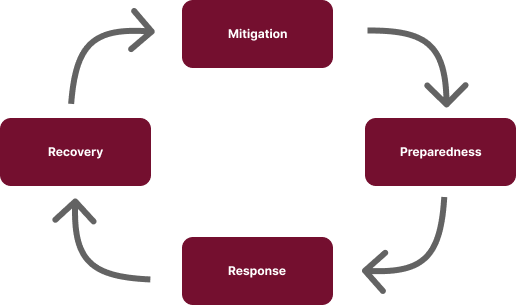
What We Do
Mitigation
Mitigation focuses on reducing risks and minimizing the impact of potential hazards before they occur.
The Office of Emergency Management works to identify vulnerabilities and implement strategies that strengthen the University's ability to withstand and adapt to emergencies.
Examples of mitigation efforts include:
- Risk and hazard assessments
- Safety and preparedness initiatives
- Policy and planning improvements
- Coordination with campus stakeholders
- Identification of critical resources and vulnerabilities
- Continuous program improvement
By proactively addressing hazards, we help create a safer and more resilient campus environment.
Preparedness
Preparedness is the foundation of a resilient campus. The Office of Emergency Management develops programs, resources, and partnerships that help build awareness and readiness across the University.
Preparedness activities include:
- Emergency planning and program development
- Campus-wide preparedness initiatives
- Training and educational programs
- Emergency exercises and drills
- Public awareness campaigns
- Preparedness resource development
- Departmental planning support
Our goal is to ensure that students, faculty, staff, and visitors know what to do before an emergency occurs.
Response
During emergencies, the Office of Emergency Management plays a critical role in supporting incident coordination and decision-making.
Working alongside University Police, campus leadership, and external response agencies, Emergency Management helps coordinate resources, information, communication, and operational support during incidents affecting the University.
Response activities may include:
- Emergency Operations Center (EOC) coordination
- Incident management support
- Emergency communications coordination
- Situational awareness and information sharing
- Resource coordination
- Stakeholder communication support
Our objective is to help ensure a coordinated and effective response that protects life, property, and University operations.
Recovery
Recovery begins as soon as an incident occurs and continues until normal operations have been restored.
Emergency Management supports recovery efforts by working with campus departments and external partners to facilitate the restoration of services, operations, and facilities.
Recovery activities may include:
- Recovery planning and coordination
- Damage and impact assessments
- Continuity planning support
- Resource identification
- Recovery documentation and after-action reviews
- Lessons learned and improvement planning
Recovery efforts not only restore normal operations but also help strengthen preparedness for future events.