
 Become A Jaguar
  Request Info
  Apply
Apply  Get Game Tickets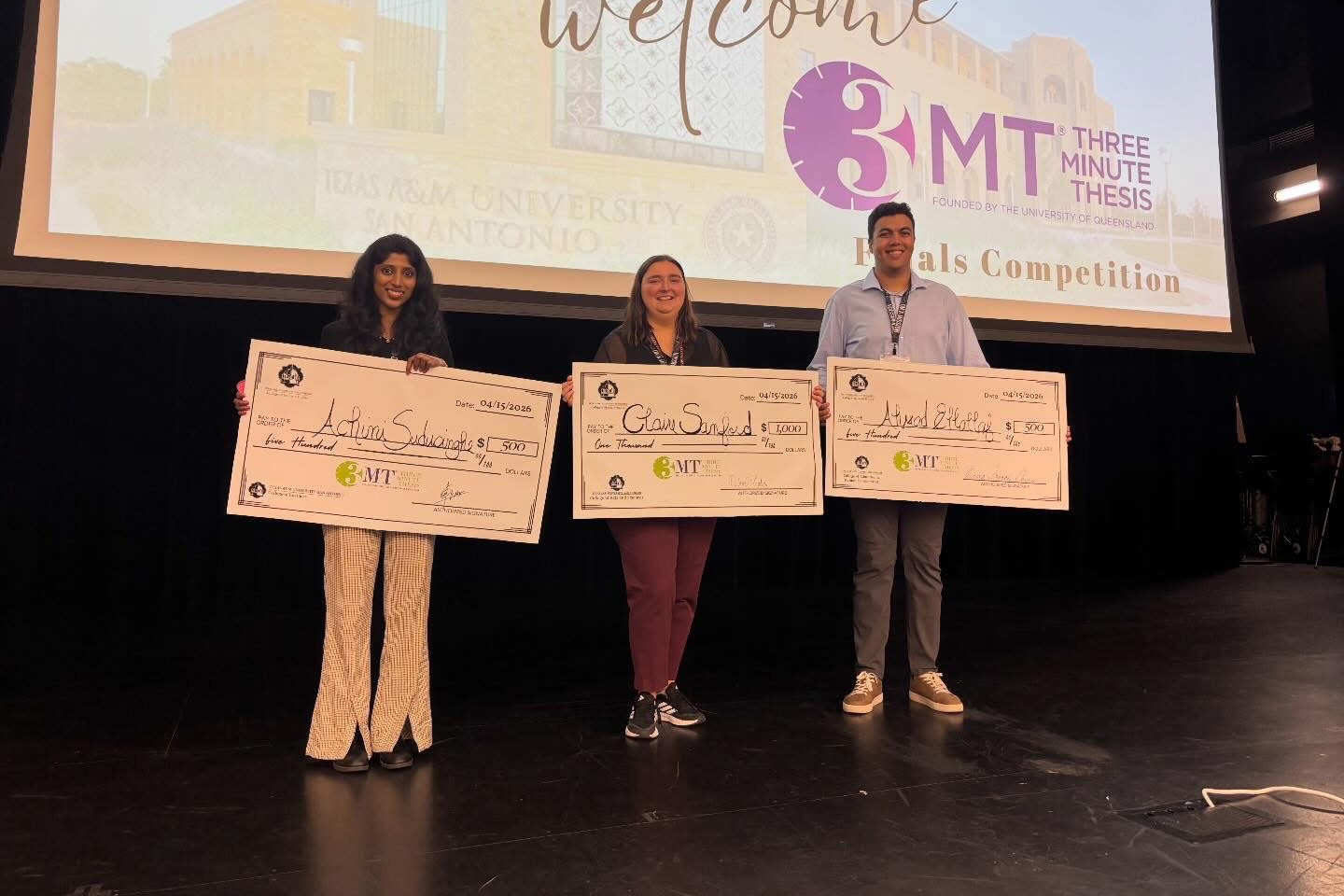
3MT Competition

The Three Minute Thesis (3MT ® ) is an academic research communication competition developed by The University of Queensland (UQ), Australia.
The Three Minute Thesis (3MT®)
Overview
The Three Minute Thesis (3MT®) competition celebrates the exciting research conducted by Doctor of Philosophy (PhD) students. Developed by The University of Queensland (UQ), the exercise cultivates students’ academic, presentation, and research communication skills. The competition supports their capacity to effectively explain their research in three minutes, in a language appropriate to a non-specialist audience.
History
The first 3MT was held at UQ in 2008 with 160 RHD (research higher degree) students competing. Enthusiasm for the 3MT concept grew and its adoption by numerous universities led to the development of an international competition. The inaugural Trans-Tasman 3MT was held at UQ in 2010 with 33 universities participating. In 2011, 43 universities were represented in the Trans-Tasman 3MT which was hosted by The University of Western Australia, and for the first time students from the United States, the United Kingdom, Canada, and Hong Kong took part in their own regional events. Texas A&M University-San Antonio held its first 3MT in the Spring of 2024.
3MT at Texas A&M University-San Antonio
Texas A&M University-San Antonio’s 3MT competition is held once per year. To determine who competes in the 3MT, a preliminary competition is held, and the top 15 competitors advance to the university-wide final and compete for cash prizes. A&M-SA winners will also have the opportunity to represent the university in regional 3MT competitions.
Eligibility
Currently enrolled Texas A&M University-San Antonio master's and doctoral students, in all disciplines, who are engaged in original research are eligible to participate in 3MT™. Presentations must focus on research students are conducting or have conducted during their current degree program, either by the student individually or as a part of a research team. The research must be at a stage where findings, preliminary conclusions, and broader impacts can be discussed. Students must be currently enrolled in graduate-level coursework, graduate-level research, or thesis/dissertation hours. Students must submit their presentation topic at the time they register to compete.
Rules
- A single static PowerPoint slide is permitted. No slide transitions, animations or ‘movement’ of any description are allowed. The slide is to be presented from the beginning of the oration.
- No additional electronic media (e.g., sound and video files) are permitted.
- No additional props (e.g., costumes, musical instruments, laboratory equipment) are permitted.
- Presentations are limited to 3 minutes maximum, and competitors exceeding 3 minutes are disqualified.
- Presentations are to be spoken word (e.g., no poems, raps, or songs).
- Presentations are to commence from the stage.
- Presentations are considered to have commenced when a presenter starts their presentation through either movement or speech.
- The decision of the judging panel is final.
Judging Criteria
At every level of the competition, each competitor will be assessed on the judging criteria listed below. Each criterion is equally weighted and emphasizes the audience.
Comprehension and Content
- Did the presentation provide an understanding of the background to the research question being addressed and its significance?
- Did the presentation clearly describe the key results of the research, including conclusions and outcomes?
- Did the presentation follow a clear and logical sequence?
- Was the thesis topic, key results, research significance, and outcomes communicated in language appropriate to a non-specialist audience?
- Did the speaker avoid scientific jargon, explain terminology, and provide adequate background information to illustrate points?
- Did the presenter spend adequate time on each element of their presentation, elaborate for too long on one aspect, or rush the presentation?
Engagement and Communication
- Did the oration make the audience want to know more? Was the presenter careful not to trivialize or generalize their research?
- Did the presenter convey enthusiasm for their research?
- Did the presenter capture and maintain their audience’s attention?
- Did the speaker have sufficient stage presence, eye contact, and vocal range, maintain a steady pace, and take a confident stance?
- Did the PowerPoint slide enhance the presentation – was it clear, legible, and concise?
Each judge assigns competitors a score of 1 through 7 for each of the criteria. Once presentations are over, the judges’ scores are combined, and the student with the highest points tally is declared the winner. Additionally, the audience casts their own ballots to select a winner for the People’s Choice Award (which is not awarded during the preliminary)
| Prize Money Awarded at the 3MT final | |
|---|---|
| Winner | $1000 |
| Runner-Up | $500 |
| People's Choice | $500 |
The winner and runner-up are both eligible to receive the People’s Choice award. Prize money is deposited into each competitor’s student account.
3MT Resources for Students
- Making the Most of Your Three Minutes
- How to present your thesis in 3 minutes
- Videos of presentations from around the world
- 3MT Competitor Guide
Contact Us
For questions, please contact Lizbett Tinoco at ltinoco@tamusaedu.